Why Does My Cat Scratch the Wall? 7 Real Reasons + How to Stop It
Published: 14 Jun 2026
What Is Actually Going On?
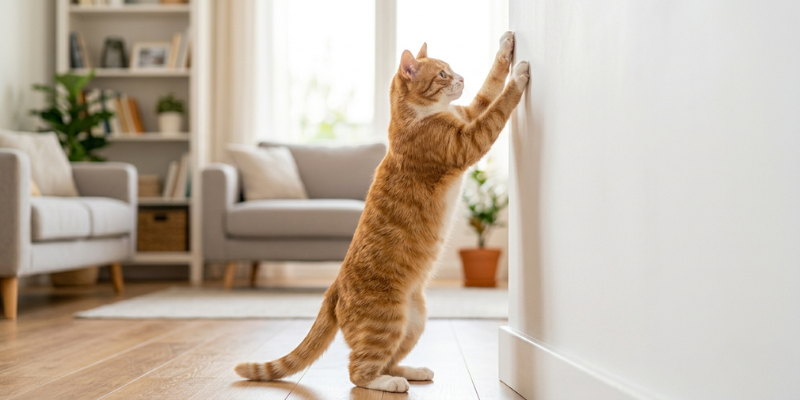
If your cat keeps going back to the same patch of wall and clawing at it, you are not imagining things — and she is not doing it to spite you. Wall scratching is one of the most misunderstood cat behaviors, partly because it seems so random from the outside.
The wall section your cat chooses is rarely random. It is usually near a high-traffic area, a doorway, a litter box, or a spot where another animal once passed through. Every scratch your cat makes on that surface is a message — to herself, to other animals, and sometimes to something you cannot even see or hear.
This guide covers all seven reasons, walks you through exactly how to stop the behavior, tells you when to worry, and gives you a practical scratching post comparison so you do not waste money on the wrong type.
Is Wall Scratching Normal in Cats?
Yes — scratching is a hardwired biological need in cats, not a behavioral flaw. According to the American Association of Feline Practitioners (AAFP), scratching serves multiple physical and psychological functions: claw maintenance, stretching, scent marking, and stress regulation.
The problem is not the scratching itself — it is the surface she is choosing. Your goal is always redirection, not elimination.
7 Reasons Why Your Cat Scratches the Wall
1. Territory Marking
Cats are territorial by nature. Even in a single-cat household with no other animals, your cat still has a strong instinct to mark her environment as “owned.” Scratching a wall leaves both a visible mark (the claw grooves) and an invisible scent mark from paw glands — a dual signal that says this space is claimed.
This behavior intensifies when there is a new pet, a new baby, a new person moving in, or even if a stray cat has been visible outside the window. Your cat is not being aggressive — she is reassuring herself.
2. Claw Maintenance — Removing the Dead Outer Sheath
A cat’s claw grows in layers, like an onion. As the outer layer gets old and dull, cats need to scratch to strip it off and expose the sharper layer underneath. This is not optional for them — it is a physical maintenance need.
Walls, particularly painted drywall, textured plaster, or brick, provide just the right resistance for this. If your cat has no suitable scratching surface, the wall becomes her nail salon.
3. Full-Body Stretching
Cats need to stretch, and they do it dozens of times a day. One of their preferred stretching positions is reaching up against a vertical surface, digging in their claws, and pulling their full body weight downward. This engages the muscles of the shoulders, back, and rear legs all at once.
Walls are perfect for this — always available, always stable, and always the right height. If your cat regularly presses herself flat against the wall with front claws extended, she is stretching, not acting out of frustration.
4. Boredom and Under-Stimulation
Indoor cats need mental and physical enrichment that matches their natural activity level. When they do not get it, they self-stimulate through repetitive behaviors — and scratching the same wall patch over and over is a classic sign of boredom.
This is especially common in cats left alone for long hours, cats in small apartments with few enrichment options, and young cats under three years old who have high energy with no outlet.
5. Stress and Anxiety
Scratching is one of the primary ways cats self-soothe under stress. The physical act releases tension, and the scent left behind makes the environment feel more familiar and safe.
Common stress triggers in cats include: a new pet or baby in the home, a move to a new house, changes in the owner’s schedule, new furniture rearranging a familiar layout, loud construction or renovation noise, and even a change in the cat’s regular food.
If your cat’s wall scratching started suddenly and coincided with any kind of change in the home, stress is almost certainly involved.
6. She Hears or Smells Something Inside the Wall
Cats can hear frequencies up to 64 kHz — roughly three times the upper range of human hearing. If there are mice, insects, squirrels, or even just pipes expanding and contracting behind the drywall, your cat can hear it. She is not scratching randomly — she is hunting something you cannot detect.
Similarly, cats have around 200 million odor receptors compared to the human average of 5 million. If another animal has ever urinated near that wall, your cat may be responding to a scent you cannot smell at all.
7. It Has Become a Habit
Sometimes the original trigger — stress, a pest, a new pet — is long gone, but the scratching continues because it has become a conditioned habit. Cats are creatures of routine. If scratching a particular wall patch has been part of daily life for weeks, the behavior is now self-sustaining.
Choosing the Right Scratching Post — The Mistake Most Owners Make
One of the most common reasons cats continue scratching walls even after their owner buys a scratching post is that the post is the wrong type for that particular cat. There is no universal “best” scratching post — what works depends entirely on your individual cat’s scratching style.
The single most important question: Does your cat scratch the wall by reaching up (vertical) or by raking along the floor or lower surfaces (horizontal)?
Vertical vs. Horizontal: How to Tell Which Your Cat Needs
| Scratching Style | Signs Your Cat Shows | Best Post Type |
|---|---|---|
| Vertical | Reaches up the wall, scratches door frames, claws at tall furniture legs | Tall sisal post, minimum 32 inches, heavy stable base |
| Horizontal | Scratches carpets, rugs, low wall sections, or the base of furniture | Flat cardboard scratcher or incline scratcher on the floor |
| Both | Scratches at multiple heights and surfaces throughout the home | Large cat tree with both vertical posts and horizontal platforms |
Material Comparison: Sisal vs. Cardboard vs. Carpet
| Material | Durability | Most Cats Like It? | Best For |
|---|---|---|---|
| Sisal fabric | Very high — 6–12+ months | Yes — most preferred overall | Cats who scratch walls and door frames |
| Sisal rope | High, but claws can snag in gaps | Usually yes | Vertical scratchers; monitor for loose strands |
| Cardboard | Low — replace every 4–8 weeks | Yes — many cats love it | Horizontal scratchers; most affordable option |
| Carpet | Medium | Variable | Not recommended if carpet scratching is already a problem |
When Wall Scratching Is a Medical Warning Sign
Most wall scratching is behavioral and completely manageable at home. However, two medical conditions can cause scratching behavior that looks unusual, compulsive, or sudden — and both require veterinary evaluation.
Feline Hyperesthesia Syndrome (FHS)
Feline Hyperesthesia Syndrome — also called twitchy cat syndrome or rolling skin disease — is a neurological condition in which a cat’s skin becomes hypersensitive, most commonly along the back and near the base of the tail.
According to Cornell University College of Veterinary Medicine, cats with FHS may react to being touched by suddenly scratching, biting at their own skin, chasing their tail, or vocalizing as if in pain. You may also notice the skin on their back visibly rippling or twitching during an episode.
FHS most commonly affects cats under 7 years old, and certain breeds — Siamese, Burmese, Persian, and Abyssinian — appear to have a genetic predisposition.
Hyperthyroidism in Senior Cats
Hyperthyroidism is common in cats over 10 years old. The overactive thyroid gland raises the cat’s metabolic rate, causing restlessness, increased vocalization, weight loss, and a general increase in repetitive or agitated behaviors — including scratching.
If your senior cat has started scratching walls more intensely than before, and is also losing weight, drinking more water, or seems unusually restless, a simple thyroid blood test at your vet is a sensible next step. Hyperthyroidism is highly treatable once diagnosed.
Step-by-Step Plan to Stop Wall Scratching
- Observe the behavior first. Is your cat tense during the scratching (stress signal) or relaxed (habit or claw maintenance)? This shapes your approach.
- Check the wall for pests. Mouse droppings, insect activity, or sounds at night. Rule out the physical cause before anything else.
- Match the scratching post to her style using the table above. Buy one and place it directly next to the problem wall — not across the room.
- Apply Sticky Paws tape to the exact wall section she targets. Replace every 2 weeks as it loses stickiness.
- Add two structured play sessions per day — morning and evening — using an interactive toy. Minimum 10 minutes each.
- If you suspect stress, plug in a Feliway Classic Diffuser in the main living area and give it 14 days to take effect before evaluating.
- Trim her nails every 2–3 weeks. Combine nail trimming with treats to build a positive association.
- If no improvement in 4–6 weeks, consult your veterinarian to rule out FHS or hyperthyroidism.
What Not to Do
- Do not punish or yell. Punishment creates fear and elevates stress, which makes scratching behavior worse. Cats do not associate punishment with past behavior.
- Do not declaw. Declawing is a surgical amputation of the last bone of each toe. It is banned or considered unethical in many countries and often causes chronic pain and worse behavioral problems.
- Do not give up on the scratching post after one week. It takes most cats 2–4 weeks of consistent reinforcement to shift scratching habits.
- Do not use deterrent spray alone without providing an alternative. Deterrents just redirect scratching to the next nearest surface. Always pair them with a post in the same location.
Does Age Change the Behavior?
Kittens (under 1 year): High-energy scratching driven mostly by play and claw-sharpening. Less location-specific than in adult cats.
Adult cats (1–10 years): Scratching is most territory-driven and habit-based. This age group responds best to redirection using scratching posts.
Senior cats (10+ years): Sudden increases in scratching in older cats — especially combined with restlessness, weight changes, or increased vocalizing — warrant a vet visit. Hyperthyroidism and feline cognitive dysfunction can both increase repetitive behaviors in senior cats.
Frequently Asked Questions
Why does my cat scratch the wall at night?
Cats are crepuscular — naturally most active at dawn and dusk, with a secondary activity window at night. Night scratching is almost always about excess energy and boredom. A structured play session of 15 minutes immediately before your bedtime is the most effective single intervention. It mimics the natural “hunt, catch, eat, groom, sleep” cycle cats are wired for.
Why does my cat scratch the wall right after using the litter box?
This is extremely common and entirely normal. In the wild, cats cover their waste to mask their scent from predators. After using the litter box, many cats extend this covering motion onto nearby walls or floors out of instinct — even though there is nothing there to cover. If it is causing wall damage, place a litter mat or cardboard scratcher beside the box to give her a more appropriate surface for the same motion.
My cat only scratches one specific wall. Why that spot?
Specific wall targeting is almost always one of three things: she is reinforcing a scent mark near a door or window, there is something behind that wall she can detect, or that spot has her established scent from previous scratching and she is maintaining it. Identify which category fits by watching when she scratches and checking for sounds or pest evidence behind that specific wall.
Is wall scratching a sign of fleas or parasites?
Wall scratching specifically is not typically associated with fleas — flea discomfort causes cats to scratch at their own skin, particularly around the neck, base of the tail, and belly. However, if your cat is doing both — scratching walls and scratching herself more than usual — flea infestation is worth ruling out. Check for flea dirt (tiny black specks) at the base of the fur near the tail.
How long will it take for the scratching to stop once I put up a post?
Realistically, 2–4 weeks for most cats when the post is placed correctly beside the scratch spot and paired with deterrent tape on the wall. Cats that have been scratching the same wall for several months may take 6–8 weeks because the habit is deeply reinforced. Consistency matters more than speed. Do not remove the deterrent tape or move the post until your cat has been using the post reliably for at least three weeks.
Final Thoughts
Wall scratching rarely comes from nowhere. Once you understand what your cat is communicating — whether it is a territorial message, a stress response, or a physical need — the solution becomes much clearer.
Most cases resolve with the right scratching post in the right location, combined with regular nail trims and enough daily play. The cats that do not respond in 4–6 weeks are telling you something a vet needs to evaluate.
For more on cat and dog behavior, explore the PetsCarez Behavior section — and if you have a specific question about your cat, drop it in the comments below.
Sources & References
- Cornell University College of Veterinary Medicine — Hyperesthesia Syndrome in Cats
- American Association of Feline Practitioners (AAFP) — Environmental Needs of Cats
- ASPCA — Destructive Scratching in Cats
- PetMD — Feline Hyperesthesia Syndrome (Vet Reviewed, 2025)
- San Francisco SPCA — Choosing Scratching Posts for Cats
- VCA Animal Hospitals — Scratching Behavior in Cats






- Be Respectful
- Stay Relevant
- Stay Positive
- True Feedback
- Encourage Discussion
- Avoid Spamming
- No Fake News
- Don't Copy-Paste
- No Personal Attacks
- Be Respectful
- Stay Relevant
- Stay Positive
- True Feedback
- Encourage Discussion
- Avoid Spamming
- No Fake News
- Don't Copy-Paste
- No Personal Attacks
