Why Does My Cat Bite Me Gently? 7 Real Reasons (Love Bites Explained)
Published: 9 Oct 2026
You’re stroking your cat. She’s purring like a little motorboat, eyes half closed, completely melted into your lap. And then, out of nowhere, she turns and sinks her teeth gently into your hand. Not hard. Not angry. Just a soft, deliberate bite. Then she goes right back to purring like nothing happened.
What was that? Was it love? A complaint? A warning? Let’s decode it.
Quick Answer
When your cat bites you gently, what owners call “love bites,” she’s usually communicating, not attacking. The most common reasons are affection, overstimulation during petting (“that’s enough”), play, attention-seeking, or, less commonly, stress or pain. Context is everything: soft, inhibited bites during relaxed moments are normal. Bites that break skin, come with flattened ears and a lashing tail, or start suddenly in a cat that never did this before deserve attention, and sometimes a vet visit.
Key Takeaways
- Gentle “love bites” are normal feline communication, but “love bite” is owner language, not a veterinary term (neither Cornell nor VCA uses it).
- The #1 trigger is petting-induced overstimulation: your cat is saying “that’s enough.”
- Learn the 3-second warning signs: dilated pupils, tail lashing, ears moved backward (Cornell University College of Veterinary Medicine).
- Never punish a bite. Redirect and watch for the signals instead.
- Sudden biting, bites that break skin, or biting paired with other behavior changes → call your vet.
What Are “Love Bites,” Really?
Here’s an honest starting point: “love bite” isn’t a veterinary diagnosis. You won’t find the term on Cornell’s or VCA’s behavior pages. It’s the name cat owners gave to gentle, inhibited mouthing. Teeth make contact, but there’s no real pressure behind it.
Veterinary behaviorists describe the same behavior differently: as communication. As VCA’s board-certified behaviorists put it, a cat that nips gently “did not intend to harm you but was trying to communicate, albeit inappropriately.” That reframe matters, because once you stop asking “why is she attacking me?” and start asking “what is she telling me?”, the answers get a lot clearer.
7 Reasons Your Cat Bites You Gently
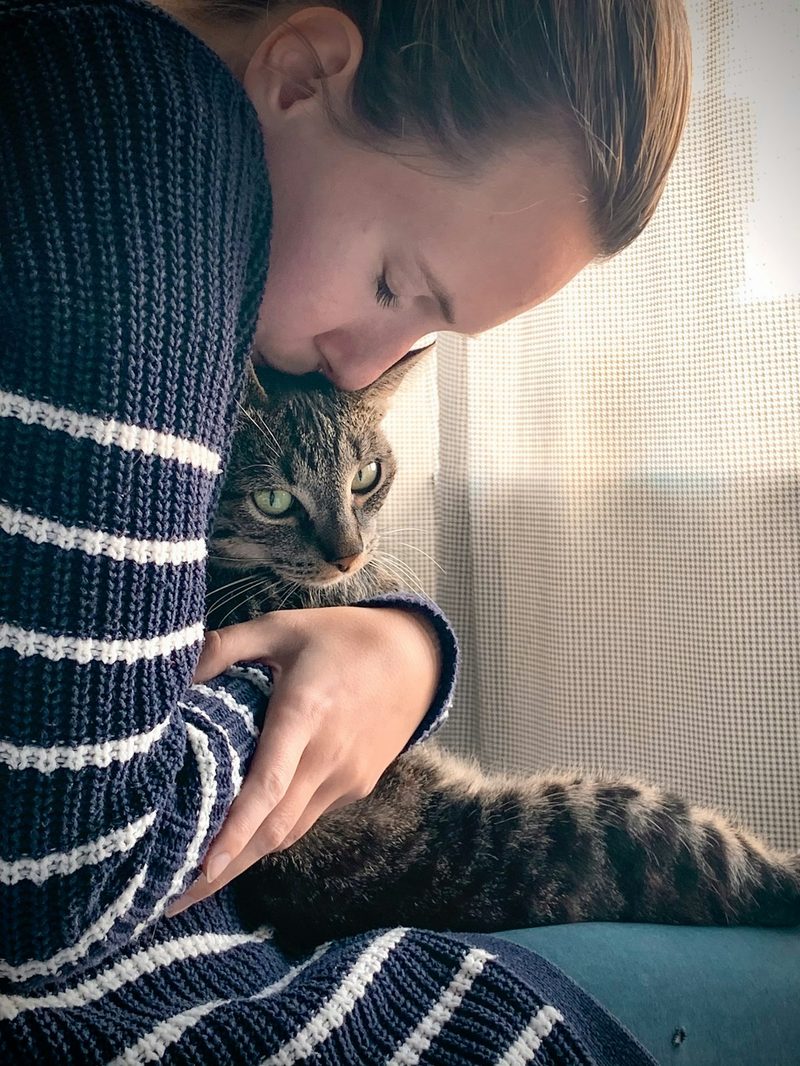
1. Affection and social bonding
Cats groom the creatures they trust. In colonies, cats groom each other, behaviorists call it allogrooming, and it’s one of the strongest social glue behaviors they have. When your cat turns that grooming instinct on you with soft nibbles, she’s essentially
treating you as family. These bites are loose-jawed, unhurried, and usually paired with purring, kneading, or slow blinks.
2. “That’s enough”: petting-induced overstimulation
This is the big one, and the most misunderstood. A cat can be blissfully enjoying petting one second and done with it the next. Cornell notes the exact reasons remain unknown, but overstimulation is a leading explanation, along with the cat simply wanting to control when the petting ends. The physical sensation of stroking, pleasant at first, crosses an invisible threshold and becomes too much.
The tell: the bite comes mid-petting-session, often after several minutes, and it’s your cat’s way of setting a boundary. This is also why “she was purring!” confuses people. Purring doesn’t always mean happy; cats also purr to self-soothe.
3. Play and predatory practice
Mouthing is how cats play. Kittens wrestle, bunny-kick, and mouth each other constantly. It’s how they learn to hunt and how hard is too hard. Young cats especially may grab your hand mid-play and nibble simply because your hand became the toy. (Which is exactly why behaviorists say: never use your hands as toys. Always redirect to a wand toy.)
4. “Pay attention to me”
Sometimes a gentle bite is a tap on the shoulder. VCA’s behaviorists describe a miscommunication pattern: your cat approaches wanting closeness or warmth, not necessarily petting, or she’s actually requesting play or food, and the bite comes from frustration when you misread the request. If the nibbles happen when you’re focused on your phone or laptop, attention is a strong suspect.
5. She never learned bite inhibition
Kittens learn how hard is too hard from their littermates. A too-hard bite ends the game, and the lesson sticks. Cornell points out that cats raised alone, without that feedback, may simply never learn soft-mouth control. If your solo-raised cat’s “gentle” bites are clumsier and harder than other cats’, this is likely why, and it’s trainable (see below).
6. Stress, anxiety, or a change at home
Cats are creatures of routine, and big feelings leak out sideways. A new home, a new pet, a new baby, a changed work schedule, even rearranged furniture can raise a cat’s baseline stress, and a stressed cat has a shorter fuse for everything, including mouthing. If the biting started around the same time as a household change, stress belongs high on your suspect list. (For more on how cats broadcast stress through behavior, see our guide on why your cat scratches the wall.)
7. Pain or a medical problem
This is the reason to take seriously. Cornell advises ruling out medical causes first when any biting behavior appears: hyperthyroidism, osteoarthritis, dental disease, and nervous-system problems can all make a cat bite. VCA adds joint, limb, neck, and back pain plus skin inflammation. A sore spot you keep stroking is a bite waiting to happen. Senior cats deserve special attention here: arthritis can make even beloved petting sessions painful. If the biting is new, escalating, or paired with appetite changes, hiding, or litter-box changes, call your vet before trying behavior fixes.
Love Bite vs Warning Bite: How to Tell in 3 Seconds
Memorize this table. It’s the fastest way to read the moment:
| Signal | Love bite | Warning bite |
|---|---|---|
| Bite pressure | Soft, inhibited, doesn’t break skin | Hard, may break skin or leave marks |
| Body language | Relaxed, purring, slow blinks | Tense: dilated pupils, tail lashing, ears moved backward on the head (Cornell) |
| During petting | Ears stay neutral, body loose | Pulls ears back, tenses body, flicks tail → stop immediately (VCA) |
| Context | Calm cuddle or play session | Out of nowhere, or escalating over days |
| Afterward | Goes back to purring or playing | Runs off, hides, or stays agitated |
What To Do When Your Cat Gently Bites You
Knowing the reason is half the battle. Here’s the practical half: all of it consistent with veterinary behaviorist guidance:
- Watch for the 3-second signals. Dilated pupils, tail lashing, ears going back. The moment you see them, stop petting immediately (VCA). Don’t try “one more stroke.”
- Keep sessions short. Learn her threshold and quit while you’re ahead. A two-minute petting session that ends well beats a ten-minute one that ends in teeth. VCA’s protocol keeps every session below the cat’s tolerance threshold and builds up gradually.
- Use an “all done” cue. VCA behaviorists recommend announcing the end of petting in a cheerful voice (“all done!”) and following it with a treat. Your cat learns the session has a predictable, pleasant ending.
- Redirect, don’t punish. Trade your hand for a wand toy the instant teeth appear. Cornell is explicit: avoid physical punishment and restraint. They increase fear and make biting worse, not better.
- Never use hands as toys. Wiggling fingers teach cats that hands are prey. Hands are for petting; toys are for biting.
- Don’t yank away fast. A fast retreating hand can trigger a chase-and-grab reflex. Go still, then calmly withdraw.
- For kittens: teach bite inhibition. When teeth press too hard, let out a short yelp, freeze, and end play for 30 seconds, the same feedback littermates give. Then offer a toy. Consistency is everything.
When a Gentle Bite Means “Call the Vet”
- The biting is NEW. Your cat never did this before (VCA: unexpected aggression deserves a thorough veterinary exam).
- It’s paired with other changes: eating less, hiding, litter-box changes, limping, over-grooming one spot.
- Your cat is a senior: arthritis and dental disease are common, invisible bite triggers (Cornell).
- The bites are escalating in frequency or force despite shorter, calmer sessions.
- What the vet will do: rule out pain and medical causes first (joints, teeth, skin, thyroid) before anyone talks behavior plans (Cornell, VCA). If needed, they may refer you to a veterinary behaviorist.
Can Cat Bites Be Dangerous?
Yes. And this is the one safety point not to skip. VCA’s behaviorists warn that cat bites easily become infected, because a cat’s sharp teeth can push bacteria deep under the skin even through a small puncture. So: any bite that breaks skin, wash it right away with soap and water, and call your doctor. Gentle, unbroken-skin nibbles don’t carry this risk, but treat every real puncture seriously. Keeping nails trimmed also reduces collateral scratches during mouthy moments.
Frequently Asked Questions
Are love bites really a sign of affection?
Sometimes, but not always. Soft nibbles during a calm cuddle, paired with purring and kneading, usually are. The same soft bite mid-petting-session more likely means “that’s enough.” Context, not the bite alone, tells you which.
Why does my cat bite me gently while purring?
Because purring isn’t a happiness guarantee. Cats also purr to self-soothe when overstimulated. A purring cat that gently bites mid-stroke is often saying the petting crossed her threshold, even though she was enjoying it a minute ago.
Why does my cat bite me gently when I stop petting her?
Usually frustration or protest. She wanted it to continue, or the sudden stop startled her. It’s the flip side of the overstimulation bite: same communication system, opposite message. A cheerful “all done!” cue before you stop prevents most of these.
My cat’s love bites are getting harder. What should I do?
First, shorten sessions and redirect to toys. Many cats escalate simply because the old pattern kept working. If the escalation is sudden, or harder bites come with other behavior changes, get a vet check for pain before assuming it’s behavioral.
Why does my cat gently bite my face or nose?
Faces and noses are high-scent, high-attention zones. Nibbling there is usually grooming-style affection. Still, keep teeth away from your face: even gentle mouths carry bacteria, and an accidental harder bite near eyes is no joke.
Should I discourage love bites completely?
Not necessarily. Soft, inhibited nibbles during calm moments are normal cat communication. Discourage, by redirecting, not punishing, bites that escalate, break skin, happen out of nowhere, or clearly signal distress.
The Bottom Line
A gentle bite is your cat talking, not attacking. Learn her three-second signals, respect the “that’s enough,” trade your hand for a wand toy, and let your vet rule out pain whenever the pattern changes. The goal was never zero teeth. It’s a cat who trusts you’ll listen before she has to insist.
Sources & References
- Cornell University College of Veterinary Medicine, Cornell Feline Health Center: “Feline Behavior Problems: Aggression” (updated December 2016).
- VCA Animal Hospitals: “Cat Behavior Problems: Petting Aggression” (updated November 21, 2022), by Ellen Lindell, VMD, DACVB; Debra Horwitz, DVM, DACVB; Gary Landsberg, DVM, DACVB, DECAWBM.






- Be Respectful
- Stay Relevant
- Stay Positive
- True Feedback
- Encourage Discussion
- Avoid Spamming
- No Fake News
- Don't Copy-Paste
- No Personal Attacks
- Be Respectful
- Stay Relevant
- Stay Positive
- True Feedback
- Encourage Discussion
- Avoid Spamming
- No Fake News
- Don't Copy-Paste
- No Personal Attacks
