Why Does My Dog Sleep at My Feet? 7 Real Reasons
Published: 21 Jun 2026
🦴 Key Takeaways
- Feet-sleeping usually signals trust and attachment, not anxiety.
- It’s tied to den instinct, scent, temperature regulation, and light protective behavior.
- A sudden, new habit of sleeping at your feet can flag stress, pain, or a household change worth watching.
What Does It Mean When a Dog Sleeps at Your Feet?
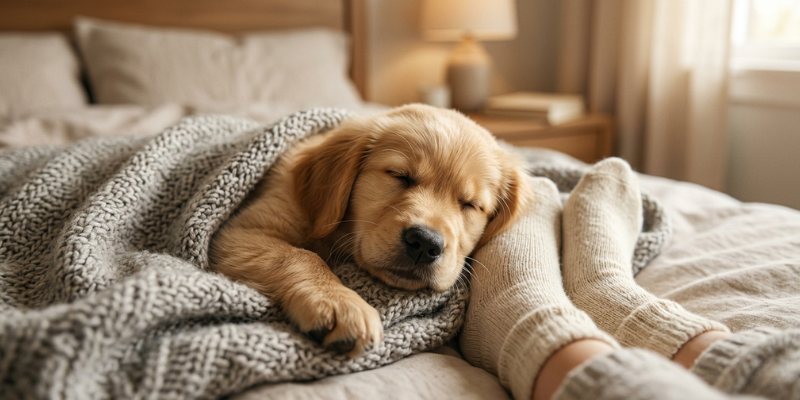
A dog sleeping at your feet means it feels safe enough to stay close to you without needing full physical contact. It’s a middle ground between sleeping pressed against you and sleeping elsewhere entirely — close enough to monitor you and pick up your scent, far enough to stretch out comfortably.
This single position is just one piece of a much bigger picture. For a full breakdown of what each spot tends to mean, see our guide to dog sleeping positions and what they reveal.
7 Reasons Your Dog Sleeps at Your Feet
In short, dogs sleep at your feet because of pack and den instinct, scent and familiarity, warmth-seeking, protective behavior, personal-space preferences, learned routine, and trust. Here’s what’s behind each one:
Pack and Den Instinct
Dogs sleep at the edges of a group because that mirrors how their den-dwelling ancestors positioned themselves for warmth and safety. Sleeping at your feet — essentially the “edge” of your sleeping space — repeats that instinct without your dog consciously understanding why.
Scent and Familiarity
Dogs gravitate to your feet because that’s where your scent is strongest, thanks to socks, shoes, and ground contact all day. Since scent is the primary way a dog identifies and feels reassured by you, settling near your feet puts it close to the most “you-smelling” part of the bed.
Warmth and Body Heat
Feet and the foot of the bed are often covered by blankets, and body heat collects there. Dogs — especially short-haired or smaller breeds — gravitate toward the warmest, most enclosed spot available.
Protective or Guarding Behavior
Some dogs choose your feet specifically because it’s a vantage point for keeping watch. Feet are also one of the more vulnerable parts of the body during sleep, and breeds with strong guarding instincts will instinctively settle there.
Personal Space and Comfort
Not every dog wants full-body contact, even if it’s deeply attached to you. Feet-sleeping offers a way to stay close without being touched all night — a comfortable middle ground for dogs that like proximity but not necessarily snuggling.
Routine and Reinforcement
Habits form quickly in dogs. If a dog slept at your feet once — maybe because it was the only space left on the bed — and nothing discouraged it, the behavior repeats and becomes the default spot.
The big one
Trust and Attachment Bond
Feet-sleeping is one of the clearest non-verbal signals that a dog considers you safe and worth staying close to. Veterinary behaviorists generally categorize it as a “low-intensity contact” position — close enough to signal attachment, but not so intense that it indicates separation anxiety.
What Other Sleeping Positions Mean
Is It Bad for a Dog to Sleep at Your Feet?
For most dogs and most households, no — feet-sleeping is harmless and even a positive sign of attachment. A few practical exceptions are worth knowing:
- Small or toy breeds can be at risk of getting kicked or rolled on if you move around a lot in your sleep.
- Restless sleepers in multi-pet households may disrupt each other’s rest if everyone is fighting for the same few inches of space.
- Senior dogs with joint issues can occasionally be aggravated by an awkward sleeping position if squeezed into a tight spot.
When a Sudden Change in Sleeping Spot Is Worth Watching
A dog that has always slept elsewhere and suddenly starts sleeping at your feet — or vice versa — isn’t automatically a problem, but it’s worth paying attention to:
- Pain or mobility issues: abrupt shifts paired with limping or reduced activity warrant a vet visit.
- Anxiety from a household change: a new baby, move, pet, or work schedule change can prompt more contact-seeking.
- Age-related clinginess: senior dogs often seek more proximity as their senses decline.
💤 How Much Sleep Does Your Dog Actually Need?
Sleep position is only half the story — sleep quantity matters just as much:
12–14h
Adult dogs, per day
18–20h
Puppies & senior dogs
Large breeds
Tend to sleep more than small breeds
Common Mistakes Pet Owners Make About Sleep Position
Assuming every position has one fixed meaning. A single night of feet-sleeping means little; a consistent, weeks-long pattern is what actually carries meaning.
Ignoring sudden behavior changes as “just a phase.” Context — recent changes at home, other symptoms, age — should always factor into whether it’s worth a vet visit.
Punishing or abruptly relocating the dog. Gradual retraining with a designated dog bed and positive reinforcement works far better than sudden enforcement.
Frequently Asked Questions
Does a dog sleeping at your feet mean they see you as pack leader?
Not specifically. Feet-sleeping is more closely tied to scent, warmth, and trust than to dominance or hierarchy.
Why does my dog only sleep at my feet, not my partner’s?
Usually scent familiarity, routine, or which person the dog spends more one-on-one time with — not favoritism.
Why did my dog suddenly start sleeping at my feet?
Could follow a household change, increased anxiety, or early joint discomfort. Mention it to your vet if paired with other changes.
Is it unhealthy for dogs to sleep on your feet every night?
For most healthy adult dogs, no — the main exceptions are very small breeds or dogs with mobility issues.
Should I discourage my dog from sleeping at my feet?
Only if it’s affecting your sleep quality or your dog’s comfort — and do it gradually, not abruptly.






- Be Respectful
- Stay Relevant
- Stay Positive
- True Feedback
- Encourage Discussion
- Avoid Spamming
- No Fake News
- Don't Copy-Paste
- No Personal Attacks
- Be Respectful
- Stay Relevant
- Stay Positive
- True Feedback
- Encourage Discussion
- Avoid Spamming
- No Fake News
- Don't Copy-Paste
- No Personal Attacks
